Two canopies, four elevations and one high-altitude sun. What we have worked out about shading a house here — the reasoning, the honest catch on every product, and the five things we cannot answer until we are standing at your window.
A farm subdivision, named for English dukes, and never once aimed at the sun.
William Grey Rattray bought the farm Klipfontein in 1891 and named its pieces after Blairgowrie, the Scottish town he came from. Craighall's streets took Scottish family names; Craighall Park's took English dukes — Somerset, Buckingham, Lancaster. Plots sold by leasehold from 1902 and freehold from 1911, and in 1919 the place was still a day from town by horse and cart.
None of that was aimed at the sun. It was set by a farm boundary and a surveyor, so which side of Buckingham your stand falls on decides whether the lounge glass takes the December overhead or the four-o'clock west.
Two things land on top of that accident. The trees: gums well over a hundred years old, some more than six metres round, left from when eucalyptus was planted here to feed the mines with timber poles. And what people build now — on stands of roughly 1,000 to 2,000 square metres, most work in this suburb is a glass-walled room grafted onto a house that has stood for decades.
So the honest answer here is almost never one specification for the house. It is one per window.
02 — The light
26 degrees south, 1,700 metres up: overhead in December, sideways in June.
Craighall Park has no weather station of its own, so everything below is Johannesburg-wide and we say so.
87°Sun's altitude at noon on 21 December — effectively straight overhead.
40°Noon altitude on 21 June, sitting due north and coming in almost horizontally.
05:13Midsummer sunrise, on a bearing of 116° — south of due east, so it reaches "south" walls.
295°Midwinter sunset bearing — well north of west, and low all the way down.
Section through a north-facing wall. The eave that shades the whole window at midday in December does almost nothing in June, when the sun sits at about 40° due north and drives light and heat right across the floor. It is why north is the cheapest elevation to solve and west the most expensive.
Wet, stormy summers; a dry, frosty winter
Roughly 784 mm of rain a year, almost all of it October to March as downpours and thunderstorms, and winter minima near 0 °C with light frost possible. Hail matters more than most people budget for: satellite work published in 2023 puts Gauteng at about 35 hail events a year across 23 hail days, running mid-November to February, with the busiest hour at four to five in the afternoon — precisely when an awning is out. That is an argument for a retractable product you can genuinely retract, not an argument for fear.
Altitude buys you extra ultraviolet
The World Health Organization's figure is simple: UV rises about 10% per 1,000 m. At roughly 1,700 m a window here takes meaningfully more of it than the same window at the coast, and thin cloud barely helps — it can scatter more down at you. Ultraviolet breaks the molecular bonds in fabric dyes, and heat and moisture speed that up, so fabric choice on a west window is a durability decision as much as a light one.
03 — The canopy
Craighall Park has two canopies, and they behave in opposite ways.
This is the part particular to this suburb, and it is why two windows four metres apart on one wall can need different answers.
The gums never leave
Eucalyptus is evergreen — its leaves are persistent, not shed in autumn. A window under one of Craighall Park's century-old gums is in shade all year, and the complaint in that room is usually the opposite of glare. It is gloom. Fit a heavy blockout there because the plan says "west" and you have built a cave. Under a permanent gum the right move is normally a fabric that passes the filtered light, closing down only when you want it closed.
The jacarandas leave exactly when you need them
Jacaranda is deciduous — a 7 to 12 metre tree that drops its canopy. It is in full leaf October to March, the months the sun is nearly overhead and the roof, not the wall, takes the load. It is bare in June and July, when the sun sits at 40° due north and comes in almost horizontally at the glass. Generous when you least need it; gone when the low sun is at its worst. A beautiful tree and a hopeless blind.
Dappled light is still direct light. Leaf shadow moves all day, thins whenever a branch does, and disappears the season after a prune.
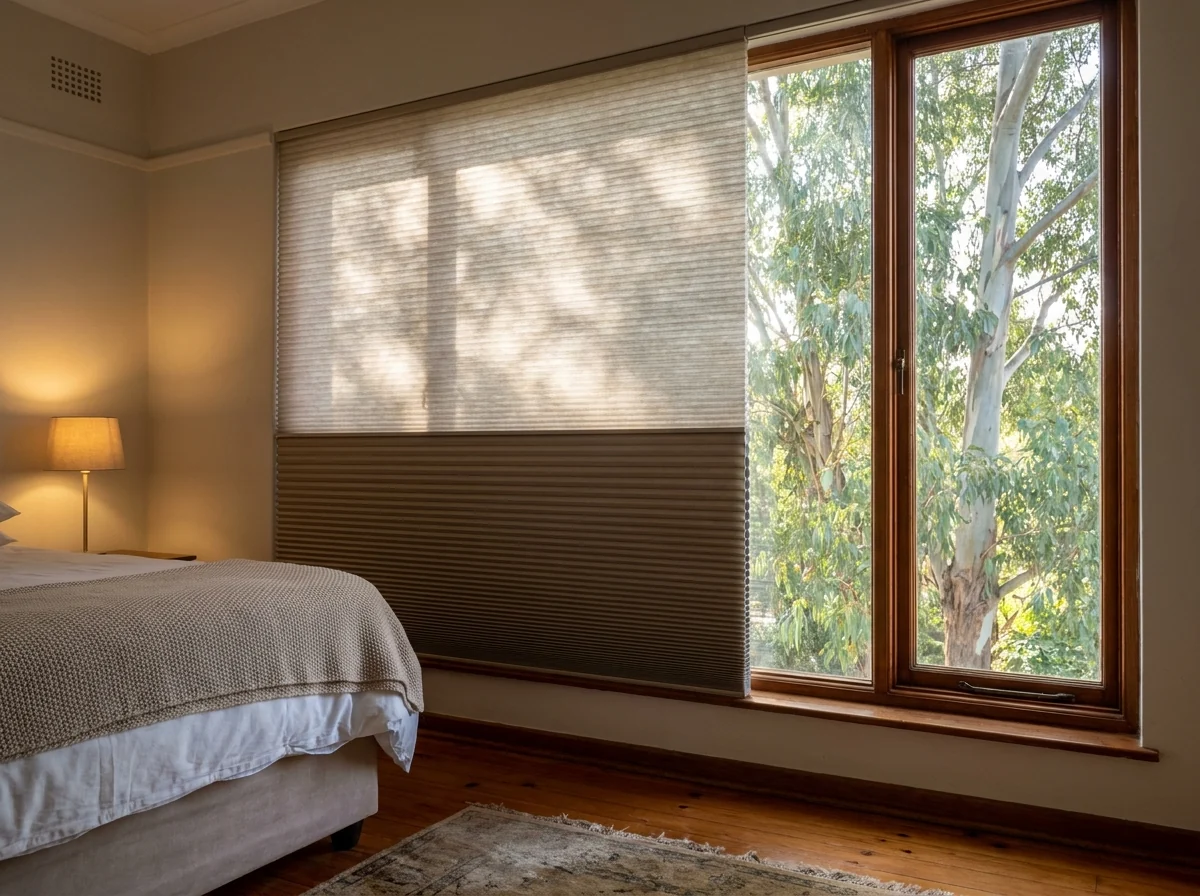
Under an evergreen gumA cellular blind lets the permanent filtered light through the top while the denser section handles privacy and heat below. Nothing hangs within reach.
04 — Orientation
Four elevations, four different problems.
Stand in the room at four in the afternoon in February. That one moment tells you more than a floor plan will.
Easiest to solve
North — geometry before you spend
At 87° in December the sun is almost straight above the wall, so an eave, veranda roof or fixed canopy throws its shadow nearly straight down and shades the whole opening — then at 40° in June the same projection lets the winter sun in to warm the room. That is the geometry SANS 10400-XA leans on for new builds, and it works as well on a 1930s house. Where the eave already exists, north is often a light-and-privacy brief rather than a heat one, which is cheaper.
The expensive one
West — the elevation that ruins afternoons
The sun sets between 243° in December and 295° in June, and by then it is low: it arrives under the eave, horizontally, at the hottest hour. Overhead projections do almost nothing. An interior blind stops the light, but the glass has already absorbed the energy and radiates it inward. Stopping it outside the pane is the only way to make the room genuinely cooler — which is why the standard treats external devices as the serious answer.
Half the penalty
East — same geometry, softer consequence
The mirror image, from 05:13 in midsummer on a bearing of 116°. Just as low and just as horizontal, but the building fabric is still cool from the night, so heat is rarely the complaint. What people report is glare on a screen, washed-out breakfast light and waking at five — usually an indoor sunscreen or day-night answer rather than an external one. That is a real saving, and worth saying out loud.
Not immune
South — late to it, but not exempt
Because midsummer sunrise (116°) and sunset (243°) both sit south of the true east–west line, a south wall does take low direct sun early and late in December, then essentially none through winter. South rooms are also the likeliest to sit under a permanent gum, so they can be the gloomiest in the house: the brief is often to add usable light and keep privacy, not to subtract heat.
Optional
Want this Field Book marked up for your own house?
Tell us which rooms or elevations are the problem and we will annotate this against your actual windows and email it back. A piece of writing, not a sales visit — nobody phones you about it.
The page stays free and open either way. There is no gated version and nothing held back.
05 — The specification
What we'd fit here — and the honest catch with each.
Every one of these is right somewhere in this suburb and wrong somewhere else. Tap "put it on my sizing sheet" and it is filled in for you further down the page — nothing to retype.
Sunscreen & blockout roller blinds
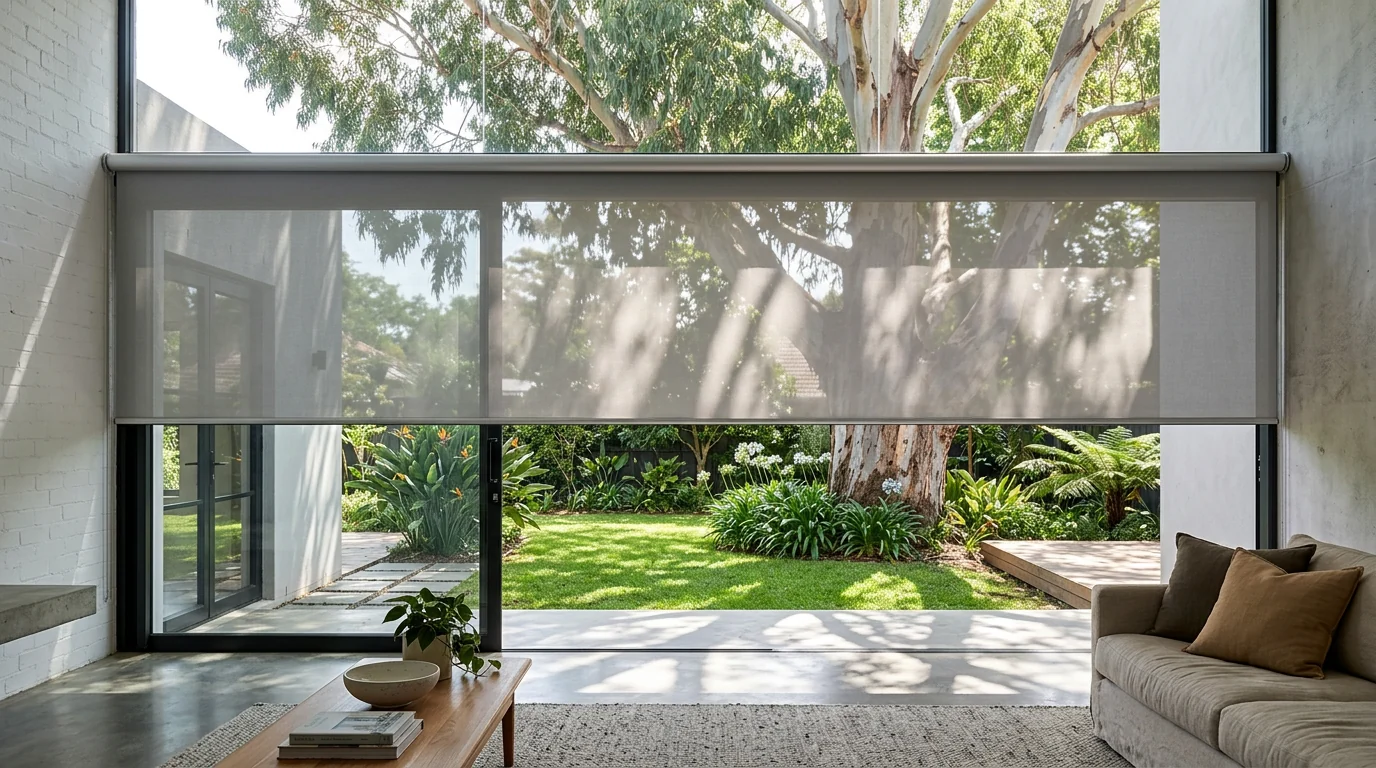
A single flat sheet on a tube — no folds, no stacking. Sunscreen mesh cuts glare and UV while keeping the garden view, which makes it the default on garden-facing glass here. Blockout is the same mechanism with an opaque fabric, for bedrooms.
The catchSunscreen gives no privacy after dark — the lit side always wins — so a bedroom that also wants a view needs two fabrics, not one. And on a west window a blockout roller stops the light but not the heat.
Day & night blinds
Alternating sheer and solid bands on one tube, so the blind runs from view-through to private without swapping fabric. On an east window — glare and early waking rather than heat — this often does the whole job alone.
The catchA compromise by design: the sheer band is not as open as a proper sunscreen and the solid band is not a true blockout. If you want a genuinely dark room, this is not it.
Cellular / honeycomb blinds
Pleated fabric folded into hexagonal cells that trap still air against the glass. That trapped air is real insulation, which earns its place against a winter minimum near 0 °C, and over a garage or under a new double-volume ceiling. Cordless versions leave nothing hanging.
The catchThe cells are fabric, so they help most where the loss is conductive and far less against direct low-angle sun. On a hard west window they are a supporting act, not the answer.
Timber & aluminium venetian blinds
Tiltable slats do something no roller can: throw light up at the ceiling while keeping the sightline out at eye level. That is genuinely useful in a gloomy room under a permanent gum. Timber suits older rooms with real proportions; aluminium is the moisture-proof pick for a scullery or bathroom.
The catchSlats collect Highveld dust and take longer to clean than a flat sheet, and a single venetian gets heavy on a wide opening — we would split it, which puts a visible join in the middle.
External venetians & roller shutters
The west-elevation answer. Both stop the sun outside the glass, so the pane never absorbs the energy — the whole difference between a cooler room and a darker one. External venetians keep a tilted view out; roller shutters are rigid aluminium slats rolling down from a headbox, the most complete shading control available on a hard elevation.
The catchThese are shading shutters, not security-rated shutters — a different product, available on request. They cost more than an interior blind, they are visible from the street, they need somewhere to house the box, and on a house over sixty the exterior fixing is exactly what the heritage rule below reaches.
Concealed & recessed blind boxes
The blind disappears into a ceiling pocket and the room reads as bare glass when it is up. Because so much work here is a new room grafted onto an old house, we can often plan the box in while the ceiling is still open — nearly free at that moment, expensive later.
The catchIt has to be decided before the plasterers finish, and some older ceilings simply lack the depth. If your extension is already boarded we will say plainly that a face-fixed cassette is the sane option.
Folding-arm awnings & zip screens
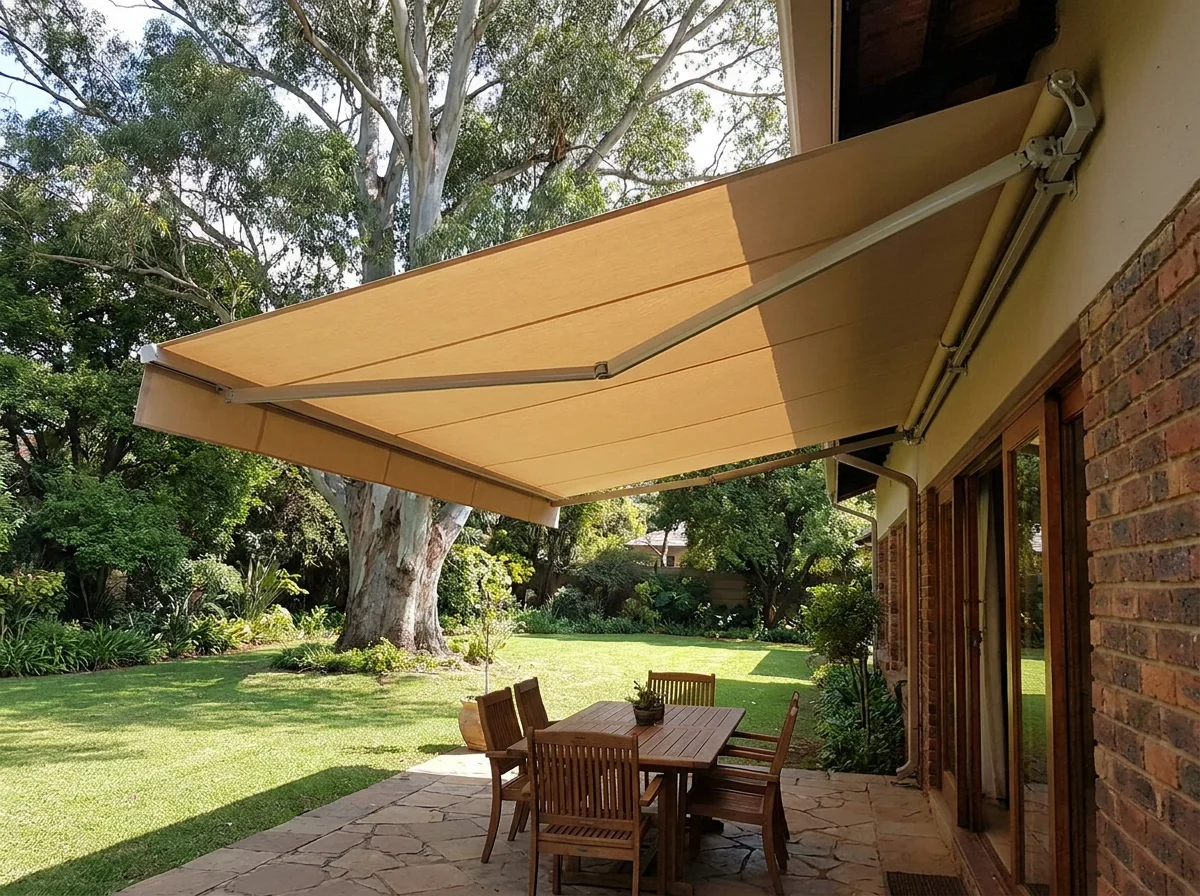
An awning shades the patio without a post in the way, so the space under it stays usable. A zip screen runs in side channels and closes the outdoor room down against wind, dust and early-evening insects — useful on gardens backing onto the Delta Park greenbelt.
The catchWith around 23 hail days a year peaking late on summer afternoons, an awning left out is an awning at risk — we would rather specify a motor and a wind sensor than pretend fabric is weatherproof. Zip screens also need sound structure either side for the channels.
Motorisation & automation
On a reachable window this is a comfort upgrade and we will say so. On a wide extension slider, a double-volume void or an outdoor awning it is close to essential — and in a house with small children it is the safest option going, because there is no cord at all. Timed closing is also the only way a west blind is reliably down before the room heats up.
The catchMotors need power at the head of the opening. Trivial in a new extension; in a 1930s wall it can mean chasing, or a rechargeable motor you top up. Which applies to you is a site-visit question, not a website one.
The west elevationRigid slats outside the pane, tilted against a low sun that arrives under the eave.The original roomsA deep reveal will usually carry an inside fit — but only a tape measure confirms it.The garden sideNo posts in the way — but how exposed that patio is decides the motor and the fixings.
06 — Heritage
The sixty-year rule, and why it only bites on the outside.
Section 34 of the National Heritage Resources Act says no person may alter or demolish any structure, or part of one, older than sixty years without a permit from the provincial heritage authority. Craighall Park's own residents' association puts it plainly on its heritage page: if your building is older than sixty years and you want to alter, extend or demolish it, you must first get approval from the Provincial Heritage Resources Authority – Gauteng, and that covers internal as well as external alterations.
The association is equally clear about its own role: "PHRAG is the decision-maker" and "we are not a statutory authority." The CRA comments at community level on streetscape context, mature trees and verges, construction impact on neighbours and the lawful sequencing of approvals — balance rather than blocking sensible improvements, because in a garden suburb the value sits in the collective feel, the canopy and the scale.
What that means for blinds, honestly:
Inside the room, nothing changes. A blind fitted within the reveal alters neither the structure nor how the house reads from Buckingham Avenue.
Outside is a different conversation. External venetians, roller shutters, a wall-fixed awning cassette, face-fixed guide channels — exterior work on a structure that may well be over sixty, which is exactly what the Act's wording reaches.
We are blind specialists, not heritage consultants. We will flag it at the measure, say which parts of the specification sit outside the wall, and point you at PHRAG and the CRA — but we will not give you a ruling on your own house.
07 — The limits of a web page
Five things only a tape measure at the window can settle.
Everything above is true and useful. None of it becomes a firm specification for your house without these five — and anyone who says otherwise is guessing.
The true reveal depth, and whether the opening is square
An inside fit needs depth enough for the tube or headrail without the fabric fouling a handle or stay. Older openings here are often a few millimetres out of square side to side, which changes the fit and sometimes the whole mounting decision.
What the frame and wall are actually made of
Steel casement, timber, aluminium, brick, plaster over lath, or a new cavity wall on the extension — each takes a different fixing and carries a different weight. A wide venetian or an awning cassette is not a light thing.
How exposed that elevation really is
Wind is the thing no website can tell you. A patio open to the Delta Park greenbelt behaves nothing like a courtyard sheltered by a wall and a century-old gum — and that decides the wind sensor, the zip screen and the fixings.
Where power for a motor can genuinely go
Motorisation lives or dies on a cable route to the head of the opening. Easy in a new extension; in a 1930s wall it may mean chasing, a surface route we would both hate, or a rechargeable motor. Five minutes to answer on site, impossible online.
What the tree above you is actually doing — at the hour that matters
Whether the canopy over that window is an evergreen gum or a deciduous jacaranda changes the specification — and so does how high the crown sits and where it has been pruned. We would rather stand in the room at the difficult hour than guess from a satellite photo.
08 — Two ways forward
Have us come and measure — or just get a range first.
Both are free, neither commits you to anything, and the first is the better answer for almost everybody.
The free expert measure & written quote
A consultant comes to the house with samples, measures every opening properly, reads the real light in each room at the hour that matters, and follows up with an itemised written quote per window. Free, no obligation, and the only way to get exact pricing.
Our consultant does five to six measures a week across this area, so the diary fills early — worth booking ahead if you need a particular day.
Or a ballpark first, if you'd rather
Want a ballpark before anyone comes out? Pop rough sizes into the sizing sheet below and we will send a budget range by the next working day. Not sure how to measure? Leave it — our consultant measures for free, and that is where the exact per-window pricing comes from either way.
Nothing here is compulsory — it is just quicker for people who would rather see a number before they see a person.
The sizing sheet — room, size, product, one row per window
Craighall Blinds — sizing sheet
Walk the house, fill this in roughly, then type it back into the form on the site. Measure the widest width and the longest drop of each opening, in millimetres. If you would rather not measure at all, the free expert measure does it for you.
Rough is fine — this is a budget range, not a manufacturing order. Anything you tapped in the chapter above is already filled in. Widths and drops in millimetres, at the widest and longest points of the opening.
Your sizing sheet — room, width, drop, mount and product for each window
Room
Width (mm)
Drop (mm)
Inside or outside the reveal
Product
Remove
Nothing on the sheet yet — and that is completely fine.
09 — The close
Book your free expert measure.
One visit does most of the job: exact sizes, samples judged in your own light, a read of each room, and a written per-window quote afterwards. No showroom trek, no pressure calls.
Anything on the sizing sheet above rides along with this form automatically. If you skipped it, that is completely fine too.
Still just researching? Say so in the timeframe box. We will note it and leave you alone — no call, no chasing — and this Field Book stays here for whenever you come back.
Sources
Where the numbers on this page come from.
Sun-path and climate figures are Johannesburg-wide; Craighall Park has no station of its own. Nothing here is a price, a lead time, or a claim about anybody else.
World Health Organization — Ultraviolet (UV) radiation Q&A ("with every 1000 m in altitude, UV levels increase by approximately 10 per cent"; cloud and time-of-day effects).
Encyclopaedia Britannica — Eucalyptus (evergreen; leaves persistent).
Craigpark Residents' Association — A Short History of Craighall Park (Rattray and the farm Klipfontein, 1891; 1902 leasehold and 1911 freehold plots; streets named after English dukes; gums well over 100 years old, planted for mining timber).
The Heritage Portal — A Short History of Craighall (a day's journey by horse and cart in 1919; gums over six metres in circumference; the pines mostly removed).
Craigpark Residents' Association — Heritage Applications (the sixty-year trigger; "PHRAG is the decision-maker"; "we are not a statutory authority"; comment on streetscape, mature trees and verges).
National Heritage Resources Act 25 of 1999 — section 34(1).
Chas Everitt — Craighall Park area profile (erf sizes of roughly 1,000–2,000 m²; mixed heritage, older and contemporary stock; Delta Park as the green northern border).
SA-Venues — Johannesburg's green spaces and Johannesburg City Parks & Zoo — Delta Park (104 hectares between Blairgowrie, Victory Park and Craighall Park; the Braamfontein Spruit corridor).
Our full working notes, including the things we could not verify and deliberately left out of this page, sit behind the same research. Where a claim is our own specification opinion rather than a sourced fact, we have written it that way.